

RSSA® for Accounting and Tax Professionals
Turn Social Security Into a Year-Round Advisory Opportunity
Help your clients connect Social Security to their broader tax and retirement picture.
Your clients already trust you with their income, taxes, and major financial decisions. The Registered Social Security Analyst® program gives CPAs, Enrolled Agents, tax preparers, and accounting professionals the specialized education and technology to help clients better understand Social Security.
RSSA® education and technology help accounting and tax professionals address these important considerations as part of a more complete planning process.


















Help Clients Make More Informed Social Security Decisions
The RSSA® Program provides education, software, and a professional credential designed to help you guide clients through important Social Security claiming decisions.

Education & Training
Build a deeper understanding of Social Security through a five-module program featuring real-world case studies, claiming strategies, and hands-on software training.

RSSA® Certification
Pass the RSSA® Final Exam to become a Registered Social Security Analyst®. Enrollment includes one exam registration with Kaplan Financial Education.

Software & Support
Annual membership includes RSSA Roadmap® software, continuing education, case and software support, and additional resources to support the Social Security services offered through your practice.
Social Security Is Already Part of Your Clients’ Tax and Retirement Picture
Social Security decisions do not happen in isolation. They can affect taxable income, retirement-account distributions, Medicare premiums, employment decisions, business-owner compensation, and long-term retirement cash flow.
As an accounting or tax professional, you already understand many of the factors that shape these decisions. RSSA® provides the specialized education and analytical technology to help you connect them.


Create a More Proactive, Year-Round Client Relationship
Tax returns often reveal what has already happened. Social Security planning gives you an opportunity to engage clients before important retirement decisions are made, creating meaningful conversations throughout the year — not only during tax season.
- Expand from tax preparation into proactive planning
- Create new off-season client engagements
- Identify tax and retirement-planning opportunities earlier
- Strengthen relationships with longtime clients
- Differentiate your firm in a competitive market
A poorly timed Social Security claiming decision can cost your clients up to $139,000 in lifetime benefits.
Understanding how tax and retirement decisions affect those benefits gives accounting professionals the opportunity to help clients protect more of their retirement income.
Where Social Security Fits Into Your Accounting Practice
Social Security considerations may influence the tax and retirement decisions your clients are already facing.
Taxable Retirement Income
Help clients understand how Social Security benefits may interact with pensions, retirement-account distributions, investment income, and other sources of income.
- How Social Security benefits may be taxed
- Interaction with pension and investment income
- Coordinating Social Security with other retirement income sources
- Household tax-planning considerations

Retirement Distributions
Add Social Security to conversations involving IRA withdrawals, required minimum distributions, Roth conversions, and retirement-income timing.
- IRA withdrawals and required minimum distributions
- Roth conversion timing
- Sequencing retirement income sources
- Retirement-income timing strategies

Medicare IRMAA
Help clients recognize how income-related Medicare premiums may fit into their broader tax and retirement-planning decisions.
- Income-related Medicare premium (IRMAA) considerations
- Coordinating claiming decisions with Medicare enrollment
- Managing income levels near IRMAA thresholds
- Broader tax and retirement-planning impact

Employment and Self-Employment
Explore how continued employment, self-employment income, the earnings test, and a client’s earnings history may affect Social Security planning.
- Working while receiving benefits and the earnings test
- Self-employment income considerations
- Earnings history and benefit calculations
- Business and retirement timing

Spousal and Survivor Planning
Help married, divorced, and widowed clients understand benefits that may be available based on their own or another individual’s earnings record.
- Spousal benefit considerations
- Divorced-spouse benefits
- Survivor benefit planning
- Coordinating benefits across a household

Business-Owner Retirement
Connect Social Security with owner compensation, tax planning, business succession, retirement timing, and the transition away from active employment.
- Owner compensation and Social Security contributions
- Business succession and retirement timing
- Coordinating with SETARA® for self-employed analysis
- Transitioning away from active employment

Bring RSSA® Training to Your Whole Firm
NARSSA offers group enrollment and education opportunities for accounting firms, tax organizations, professional associations, and enterprise groups. Group options can make it easier to bring Social Security knowledge to multiple professionals within the same organization.
Discuss a Firm or Group EnrollmentBuilt for Self-Employed and Business-Owner Conversations
Connect Today’s Tax Decisions With Tomorrow’s Social Security Benefits
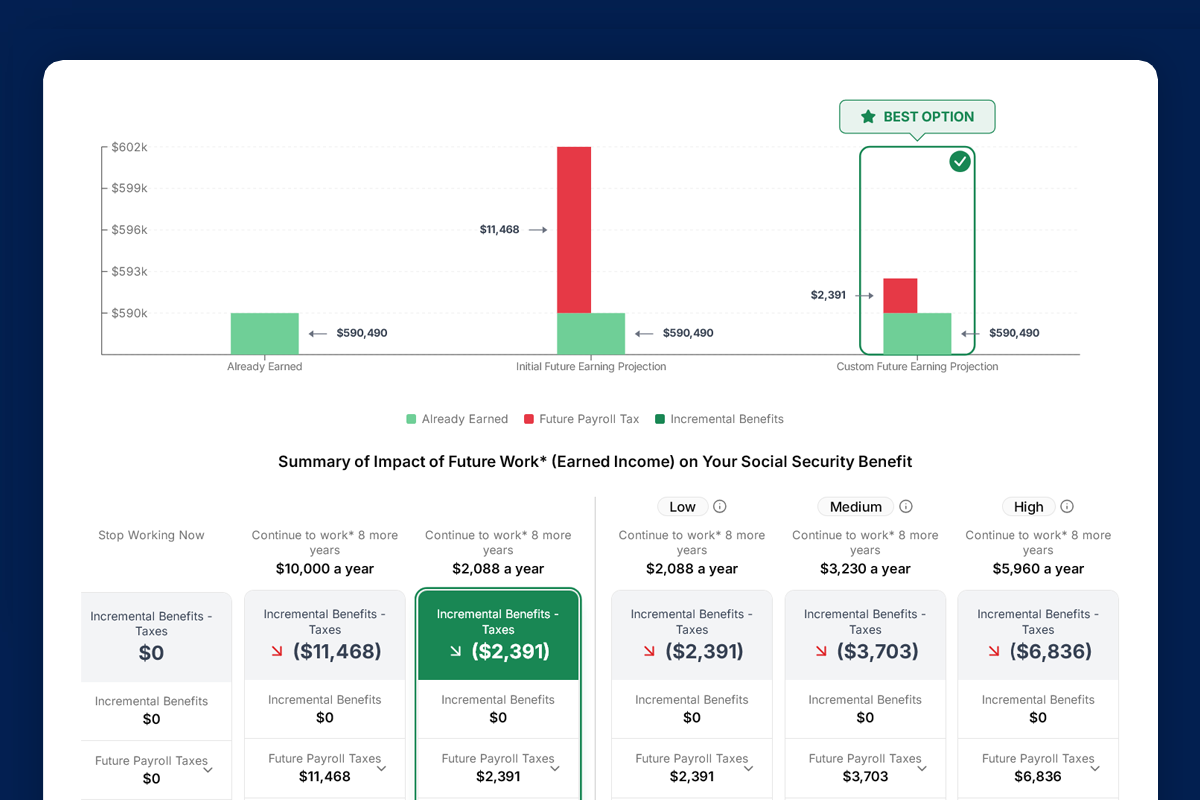
A client’s reported earnings and compensation decisions can affect current taxes, Social Security contributions, and future retirement benefits. SETARA® (Self-Employed Tax and Retirement Analysis tool) helps illustrate these relationships so clients can better understand the potential long-term implications of decisions they are making today.
- Self-employment income and owner compensation
- Social Security and Medicare tax considerations
- Reported earnings and Social Security earnings history
- Long-term tax and retirement-income planning
Turn Complex Social Security Details Into Clear Guidance
RSSA Roadmap® handles the calculations behind a Social Security analysis and presents the results in a format that is easier to interpret, compare, and explain to clients.
- Import benefit information using an SSA.gov file
- Evaluate spousal, survivor, and divorced-spouse benefits
- Compare claiming ages and breakeven points
- Review taxation and Medicare IRMAA considerations
- Create client-friendly reports in English or Spanish

Add Specialized Social Security Knowledge to Your Practice

CPA, EA, or PTIN Eligibility
A CPA credential, Enrolled Agent status, or active IRS PTIN may satisfy the RSSA® program’s professional eligibility requirement.

Flexible Online Education
The five-module program is self-paced. Most participants complete it in approximately 20–35 hours.

Proctored Final Exam
Administered and proctored online by the College for Financial Planning® — a Kaplan Company.
Hear What RSSAs® Are Saying About the Program

“Becoming a Registered Social Security Analyst® has opened doors to multiple clients and referrals. When I tell them I’m an RSSA®, they want to know more.”
Frank Garcia

“After completing the RSSA® program, I was immediately able to apply my Social Security knowledge to help a client make informed decisions about their benefits.”
Jeanine Kinzie

“Being able to help people get into a better position is so important, and I can do that because of the knowledge that being an RSSA® provides.”
Erin Fountain

“Having the RSSA® designation gives me more credibility and trust with clients. It’s not just about being a financial advisor—this shows I truly understand Social Security.”
Catherine Allen-Carlozo
Frequently Asked Questions
Why Is Social Security Relevant to an Accounting or Tax Practice?
Social Security can interact with taxable income, retirement-account distributions, Roth conversions, employment income, self-employment, Medicare IRMAA, and broader retirement planning. Accounting and tax professionals are well positioned to help clients understand these connections.
What Is SETARA®?
SETARA stands for Self-Employed Tax and Retirement Analysis. It is a specialized tool within the RSSA Roadmap® designed to help professionals illustrate how reported earnings and related tax decisions may affect a self-employed client’s future Social Security benefits and broader retirement picture.
Are CPAs and Tax Professionals Eligible to Earn the RSSA® Designation?
Yes. A CPA credential, Enrolled Agent status, or active IRS PTIN may satisfy the RSSA® program’s professional eligibility requirement. Additional professional licenses and designations may also qualify.
Does the Program Provide Continuing Education Credit?
Yes. RSSA® education is approved for up to 15.5 NASBA CPE credits for CPAs and 10 IRS CE credits for eligible tax professionals. Eligibility and reporting requirements may apply.
How Much Time Does the RSSA® Program Take to Complete?
Most participants complete the five-module program in approximately 20 to 35 hours. The education is delivered online and is self-paced.
Does the Program Include Social Security Analysis Software?
Yes. RSSA® membership includes access to RSSA Roadmap® and SETARA®, which help professionals evaluate Social Security options, illustrate self-employed tax and retirement scenarios, and create client-friendly reports.
Make Social Security Part of Your Year-Round Advisory Practice
Build specialized knowledge, serve self-employed clients and business owners more effectively, and bring Social Security into the tax and retirement conversations your clients are already having.
Speak with our team about individual enrollment, firmwide education, association partnerships, and enterprise opportunities.
Schedule a Call
Have Questions or want to see how the RSSA® Program fits into your practice?
Schedule a quick call with our team to walk through the program, software capabilities, and how other accounting and tax professionals are successfully implementing it into their practices.
Choose a TimeCPA / EA / PTIN Eligibility · Proctored by College for Financial Planning® — a Kaplan Company · Listed in the FINRA Professional Designations Database · SOC 2 Type 2 Compliant